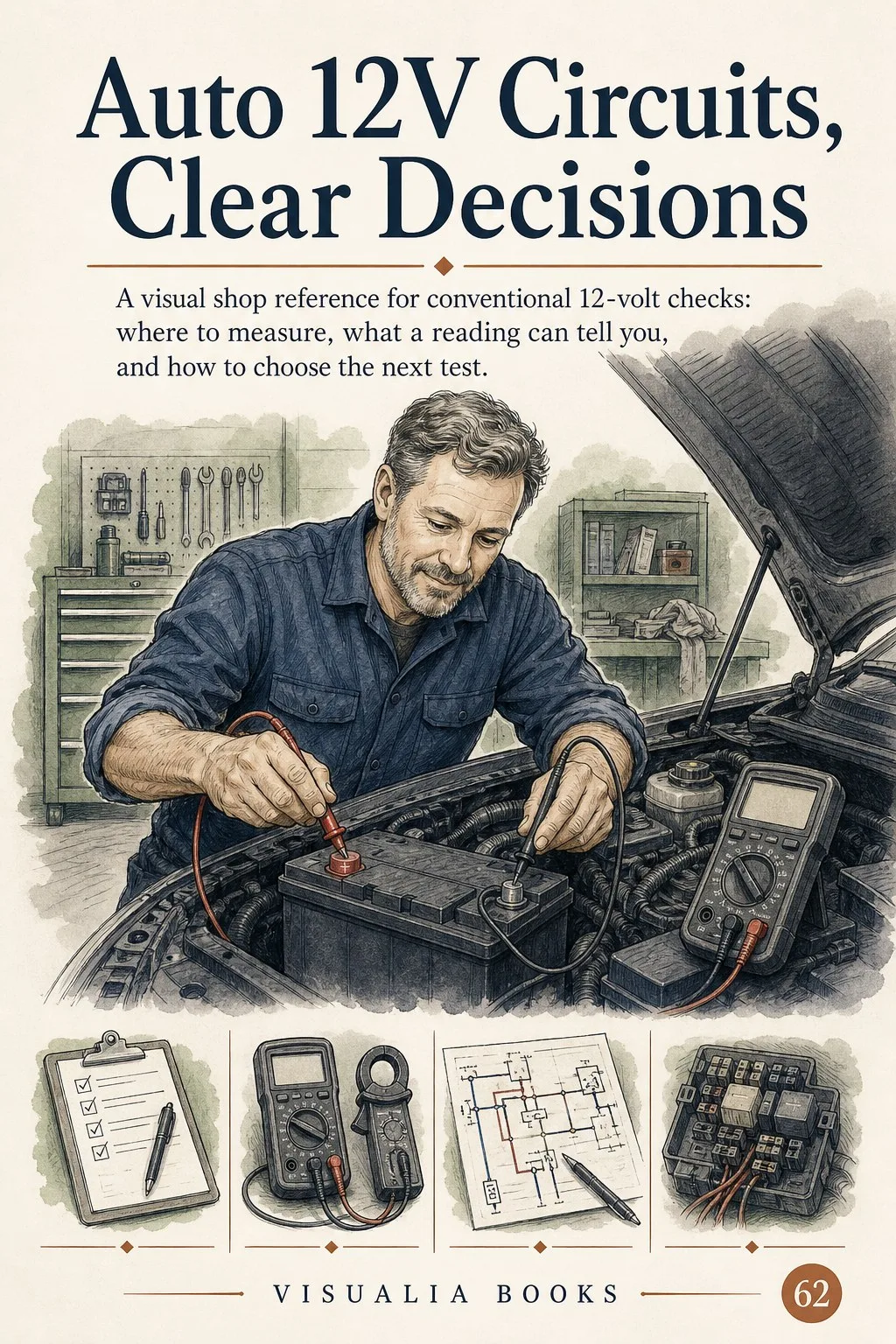
Keep conventional 12-volt checks within reach See where to measure and what to check next

Illustrated reminders to support diagnostic decisions alongside vehicle-specific service information. 62 illustrated pages.

PDF reference for working auto technicians

BUY NOW

🔒 Secure checkout · PDF by email · 30-day guarantee

62illustrated pages
9parts
2bonus books included
PDFby email · printable

This Is What the Pages You Will Study Look Like

Preview seven actual topic pages before deciding. Read the PDF on a device or print pages for your bench.

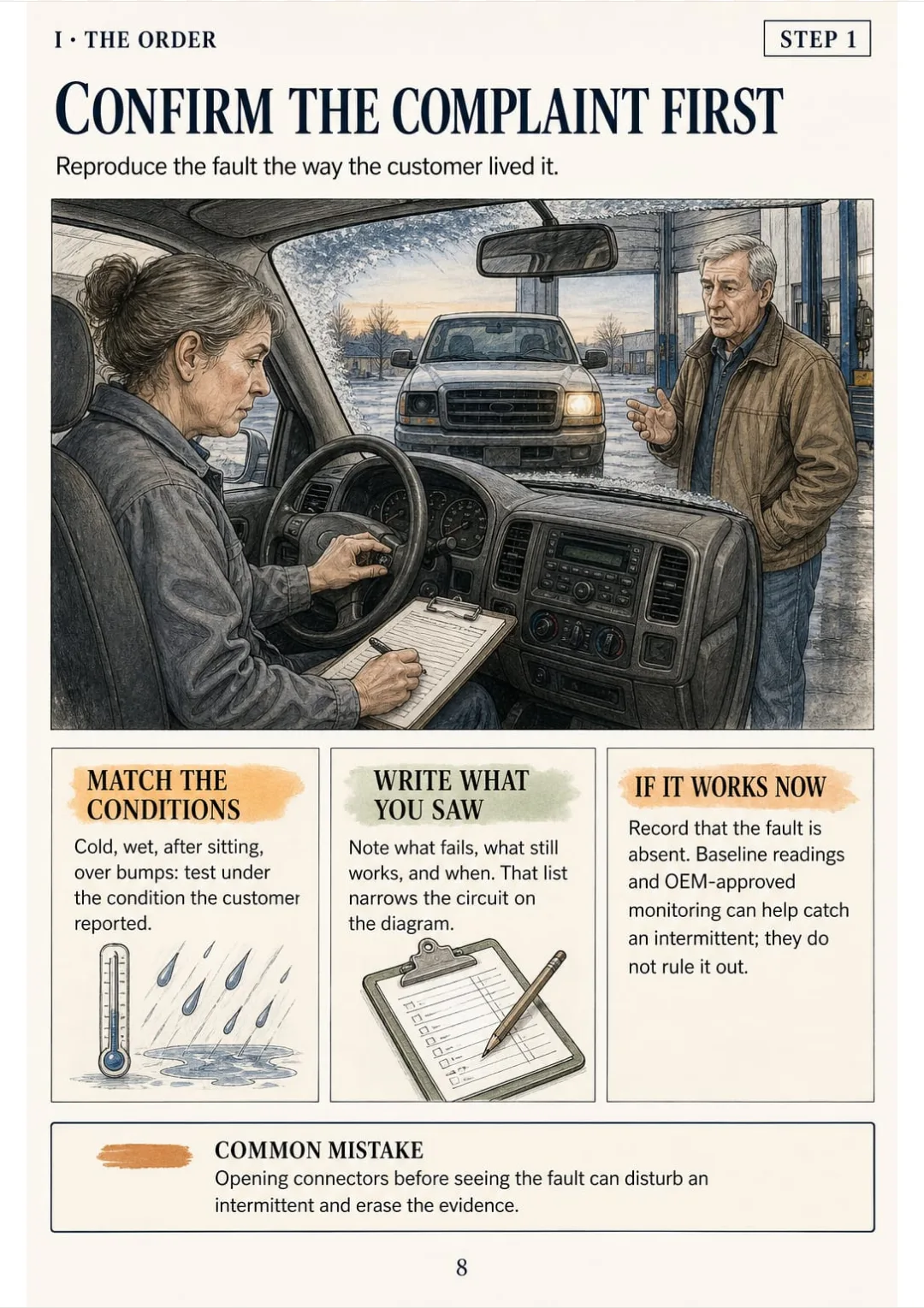
Document the complaint and conditions; if an intermittent fault is absent, record the baseline without ruling it out.
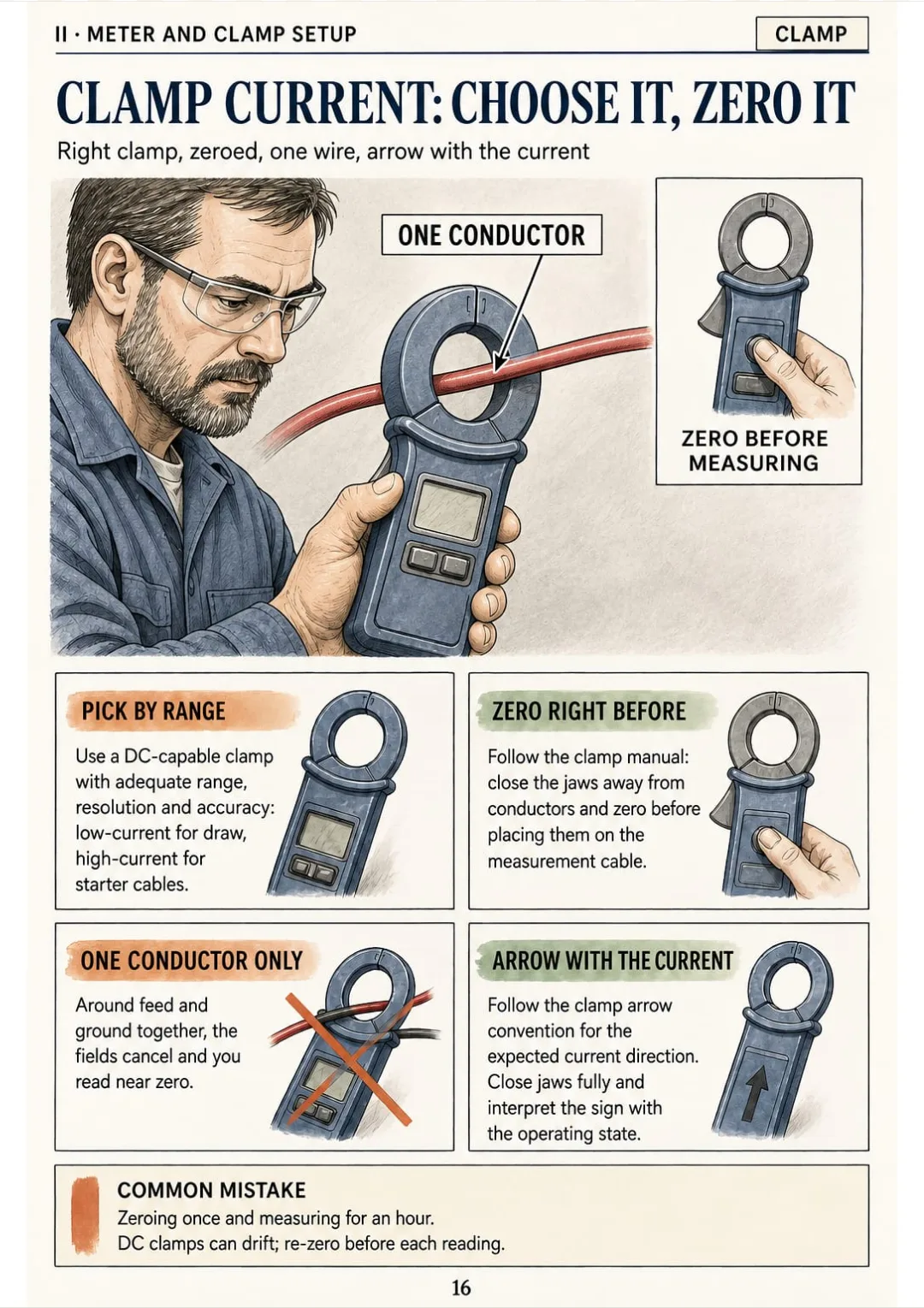
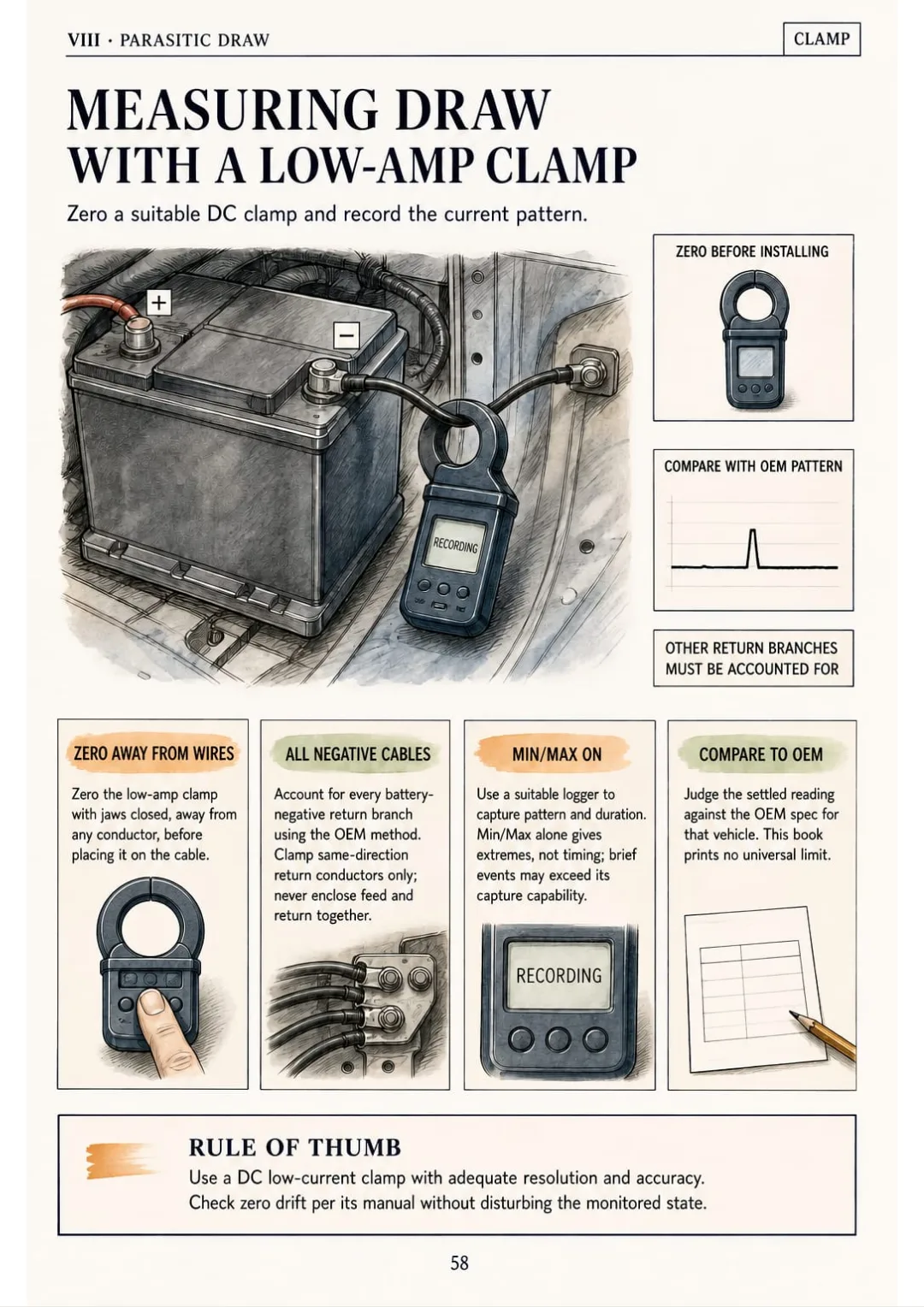
Use a suitable DC clamp, zero it with empty closed jaws and measure the identified conductor.
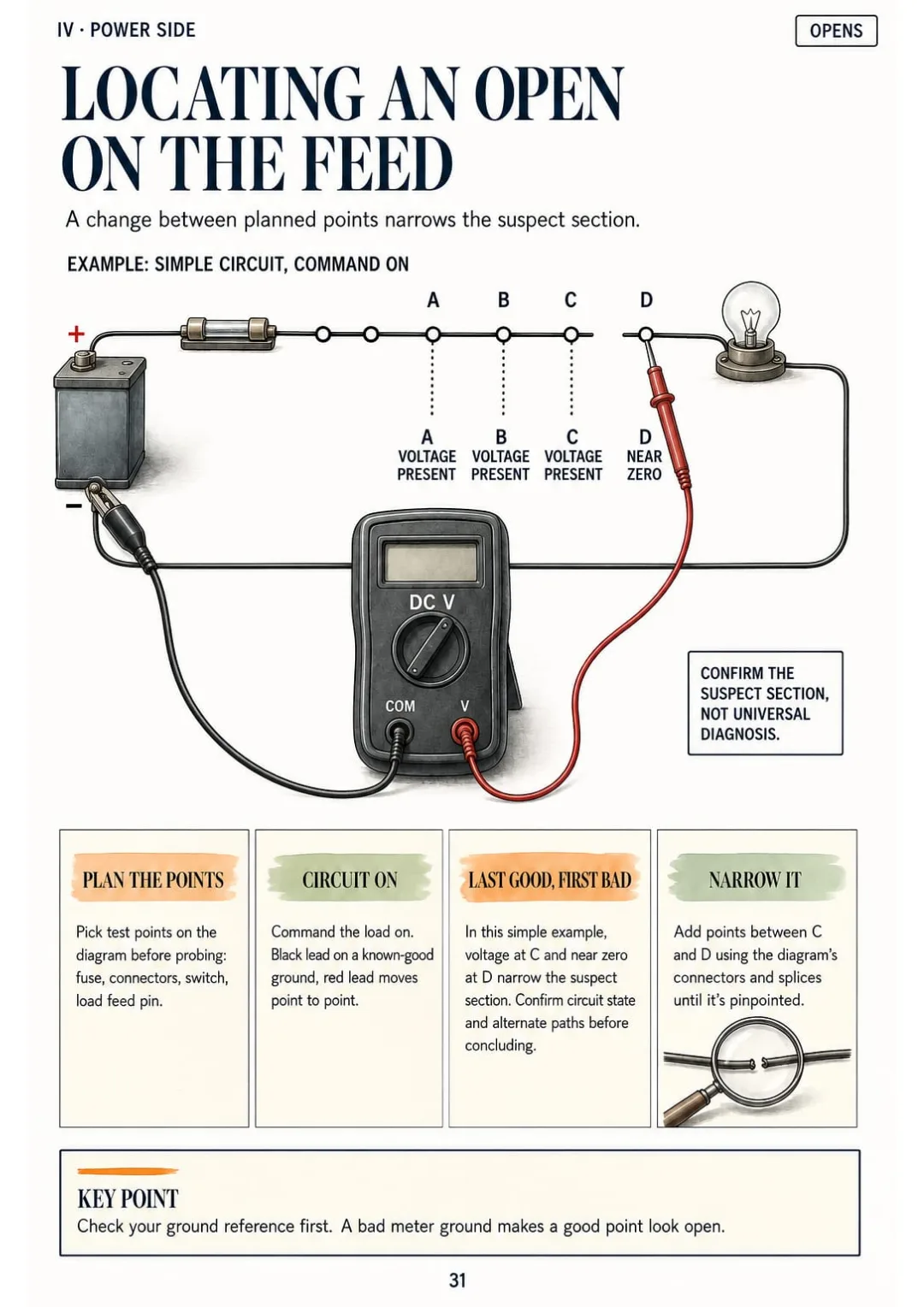
Simple example: compare adjacent points to narrow a suspected open; confirm with the OEM procedure.
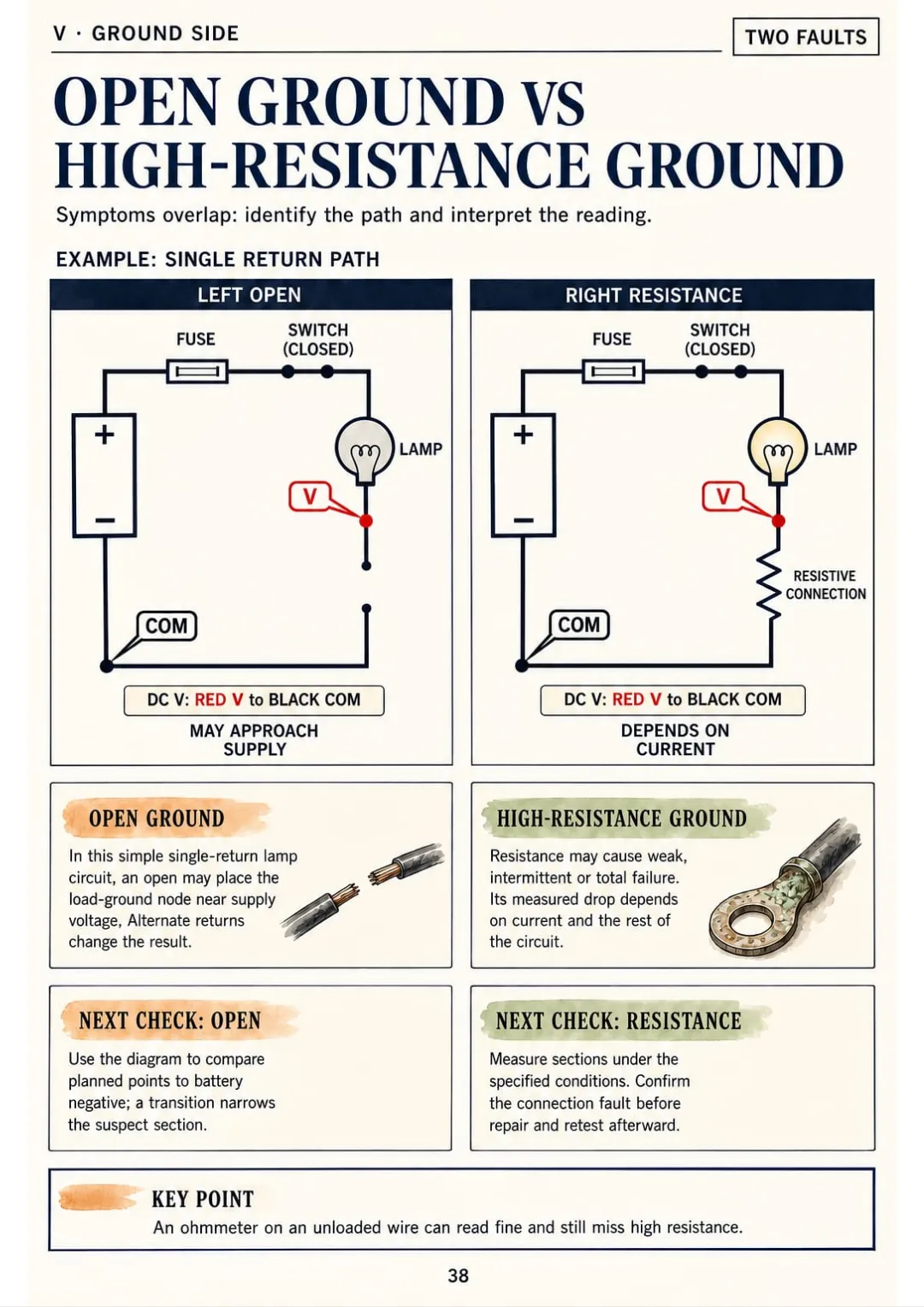
Illustrative single-return circuit: voltage and symptoms depend on topology and load current.
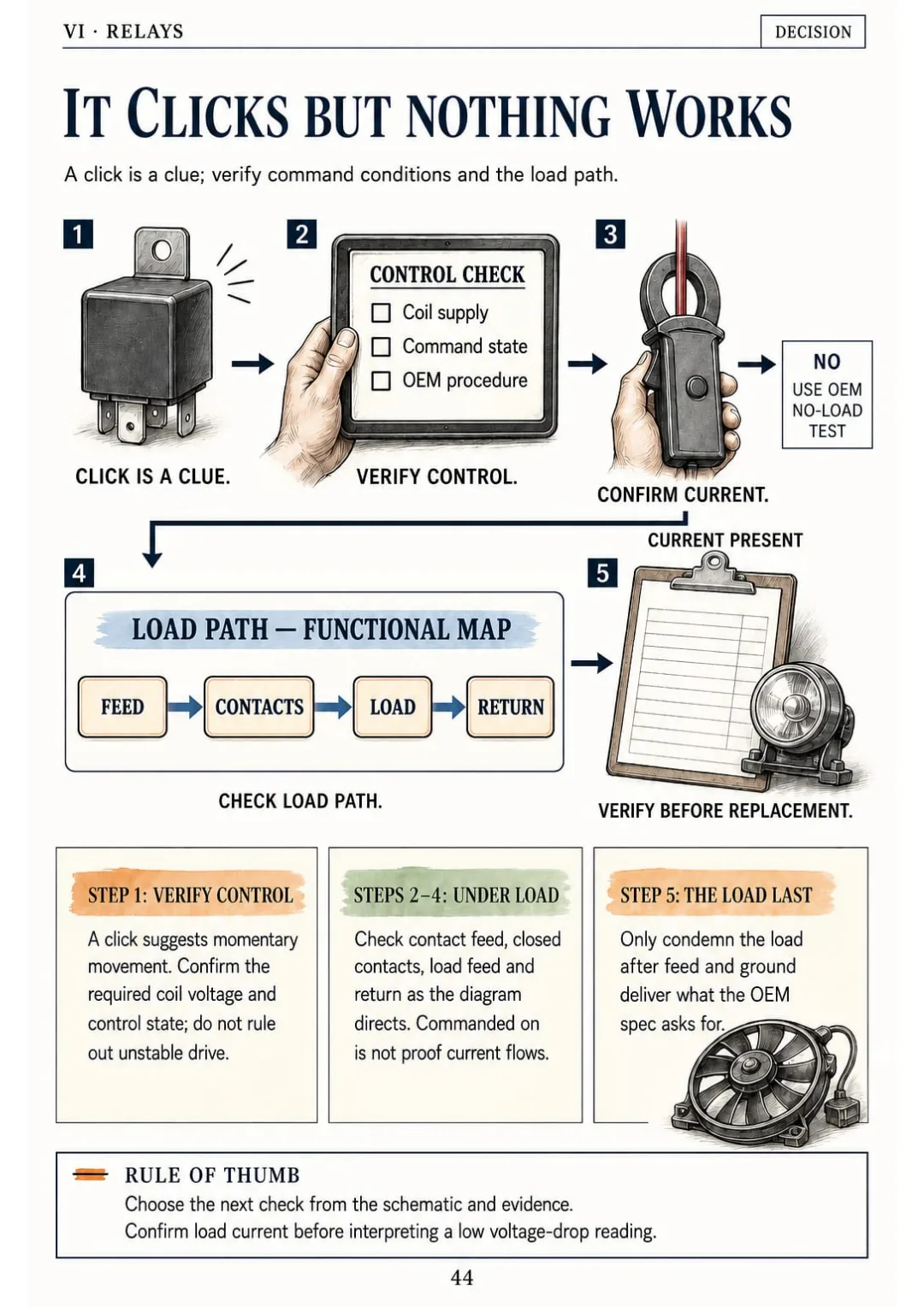
A click does not prove the coil drive or contacts healthy; verify the required operating conditions.
Account for return branches, clamp resolution and the expected current pattern; Min/Max alone does not record timing.
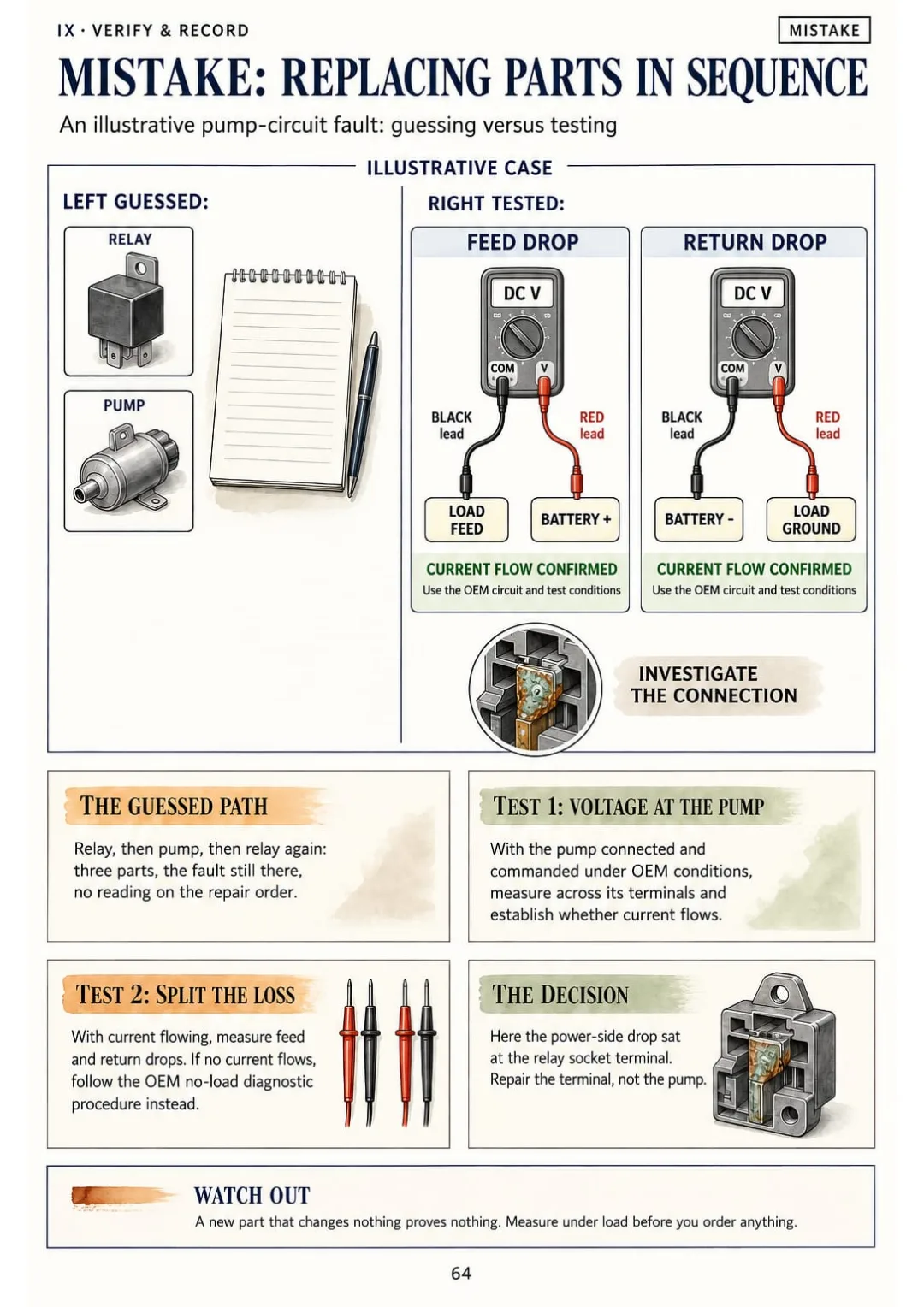
Illustrative case: feed and return measurements help investigate a connection fault before choosing another part.

Swipe to see more · tap to zoom →

These are real pages from the book. The table of contents is the full one: 9 parts and 62 topics.

Before another part, clarify what the reading tells you

A voltage reading is useful only with its reference point, circuit state and test conditions. An unloaded reading does not establish load capacity.

A repeat complaint can leave you reviewing the same diagram and trying to reconstruct which checks were completed. Clear notes preserve the evidence.

These pages give trained technicians visual reminders for the checks covered here, so the next measurement answers a defined question.

Illustrative case: feed and return measurements help investigate a connection fault before choosing another part.

This illustrative pump-circuit case compares parts swapping with measurements that isolate a connection problem.

The example teaches how to interpret evidence; it does not promise the same fault or result on your vehicle.

Keep the test conditions and the next question beside the drawing.

Parts you didn't need

Replacing an unconfirmed suspect can add parts and labor while leaving the original complaint unresolved.

Hours spent guessing

Tracing the same circuit twice because you forgot which test you ran. Watching three videos that each start from a different point.

Your reputation on the lift

A clear repair record helps explain what was measured, what was repaired and how the result was checked.

BUY NOW

🔒 Secure checkout · PDF by email · 30-day guarantee

SEE THE DIFFERENCE

The same topic studied two ways

THIS
  • Read a dense paragraph explaining how to locate an open on the power feed
  • Try to remember which test point comes next while you're under the hood
  • Hope you picked the right ground reference and the right meter range
In a simple feed circuit, measurements at planned points can help narrow a suspected open. First identify the circuit, command conditions, approved access and reference point from OEM service information. Compare the measured potential at adjacent points with the expected state. A change may identify a section for further testing, but switch state, leakage and alternate paths must also be considered before a conclusion.
FOR THIS
  • See the simple example circuit with planned test points and an identified reference.
  • Use the vehicle diagram to find suitable access points and the relevant conditions.
  • A change between adjacent readings narrows the section to investigate; confirm before repair.
Simple example: compare adjacent points to narrow a suspected open; confirm with the OEM procedure.
CONTENTS

Take a Look at the 9 Parts and 62 Topics

Nine parts covering measurement setup, diagrams, feed and return checks, relays, starting and charging, draw testing and records.

IThe Order and the Core Rule · pp. 5-11
  1. The same order on every 12-volt job
  2. Continuity doesn't prove a circuit can carry its load
  3. Every circuit has five parts: feed, protection, control, load, ground
  4. Confirm the complaint before you touch a wire
  5. Open-circuit voltage: what it proves and what it doesn't
  6. How to use the OEM spec box on each page
  7. What this book doesn't cover, and why
IIMeter and Clamp Setup · pp. 12-19
  1. DC volts: range, jacks and reference point
  2. Back-probing without damaging terminals
  3. Loaded test versus unloaded test
  4. Resistance only on a de-energized circuit
  5. Current with a clamp: choosing it and zeroing it
  6. The A input never goes across the battery
  7. Min/Max and recording for intermittent faults
  8. Load the circuit with its own component
IIIReading the Wiring Diagram · pp. 20-26
  1. The symbols you'll meet on every diagram
  2. Follow power from the fuse box to the load
  3. Find the ground path and the shared grounds
  4. Connector views and pin numbering
  5. Relay pins on an identified schematic
  6. Labels, not just wire colors
  7. Plan your test points before you open the hood
IVPower Side: Feeds, Fuses and Opens · pp. 27-34
  1. Power-side voltage drop under load
  2. Split the feed into sections to find the loss
  3. Fuses: test both sides with the circuit on
  4. A blown fuse is a symptom, not the fault
  5. Locating an open circuit on the feed
  6. High resistance hides behind good voltage
  7. Switch contacts under load
  8. Splices and fusible links
VGround Side · pp. 35-40
  1. Ground-side voltage drop under load
  2. Body, engine and battery grounds
  3. One shared ground, several symptoms
  4. Open ground versus high-resistance ground
  5. Ground straps after body or engine work
  6. Terminal fit: when the pin looks good but fails
VIConventional Relays and Control · pp. 41-47
  1. A relay is two circuits: control and contacts
  2. Testing the relay control side
  3. Testing the relay contact side under load
  4. It clicks but nothing works
  5. Swapping a relay: what it proves and what it doesn't
  6. Diodes and resistors in the relay coil
  7. When the control comes from a module
VIIBasic Starting and Charging · pp. 48-55
  1. Know the battery's state before any test
  2. Battery test following the manufacturer's procedure
  3. Slow crank: drops on the cables during crank
  4. The starter control circuit
  5. Starter current with the clamp, never the DMM
  6. Charging output: compare to the OEM spec
  7. Drops in the charging circuit
  8. No crank: the decision path
VIIIParasitic Draw and Vehicle Sleep · pp. 56-60
  1. Preparing a parasitic draw check without disturbing it
  2. Let the vehicle go to sleep
  3. Measuring draw with a low-amp clamp
  4. Finding the circuit with drops across fuses
  5. What wakes the modules up again
IXVerify, Record and Repeat · pp. 61-66
  1. Verify the repair under the same conditions
  2. Write the repair order the next tech can follow
  3. Frequent mistake: continuity-only testing
  4. Frequent mistake: replacing parts in sequence
  5. The whole order on one page
  6. Quick reference: what each reading proves

One topic per page, with labeled reminders

Use the page to review the test conditions, relevant measurement points, interpretation and next check. Adapt the procedure to the vehicle and the evidence.

A click does not prove the coil drive or contacts healthy; verify the required operating conditions.

The relay example separates a click from proof of healthy coil drive or contact capacity.

A command to turn on does not establish current flow; low voltage drop without current is not a pass.

A reference beside the job, used with your training and OEM information.

BUY NOW

🔒 Secure checkout · PDF by email · 30-day guarantee

Here Is What You Get with Auto 12V Circuits, Clear Decisions:

Ipp. 5-11

The Order and the Core Rule

A diagnostic framework, the simple lamp circuit, measurement limits and how to use OEM specifications.

IIpp. 12-19

Meter and Clamp Setup

DC volts, voltage drop, resistance, clamp current, and why the A input never goes across the battery.

IIIpp. 20-26

Reading the Wiring Diagram

Symbols, power paths, ground paths, connector views, relay pins, and planning test points before you open the hood.

IVpp. 27-34

Power Side: Feeds, Fuses and Opens

Voltage drop under load, fuses tested with the circuit on, locating opens, high resistance, switch contacts, and splices.

Vpp. 35-40

Ground Side

Ground-side voltage drop, body and engine grounds, shared grounds, open versus high-resistance ground, and terminal fit.

VIpp. 41-47

Conventional Relays and Control

Control side and contact side tested separately, the relay that clicks but does nothing, and module-controlled relays.

VIIpp. 48-55

Basic Starting and Charging

Battery state first, slow crank drops, starter control and current with the clamp, charging output, and the no-crank decision path.

VIIIpp. 56-60

Parasitic Draw and Vehicle Sleep

Preparing without disturbing the draw, letting the vehicle sleep, measuring with a low-amp clamp, and finding the circuit.

IXpp. 61-66

Verify, Record and Repeat

Repair verification, useful records, illustrative mistakes and a printable diagnostic framework.

And That Is Not All: 2 More Books, Free

12V Diagnostic Log Sheets

BONUS 1: «12V Diagnostic Log Sheets»

Write down every test in the same order, with conditions and readings, so you can compare before and after the repair and practice on worked example cases.

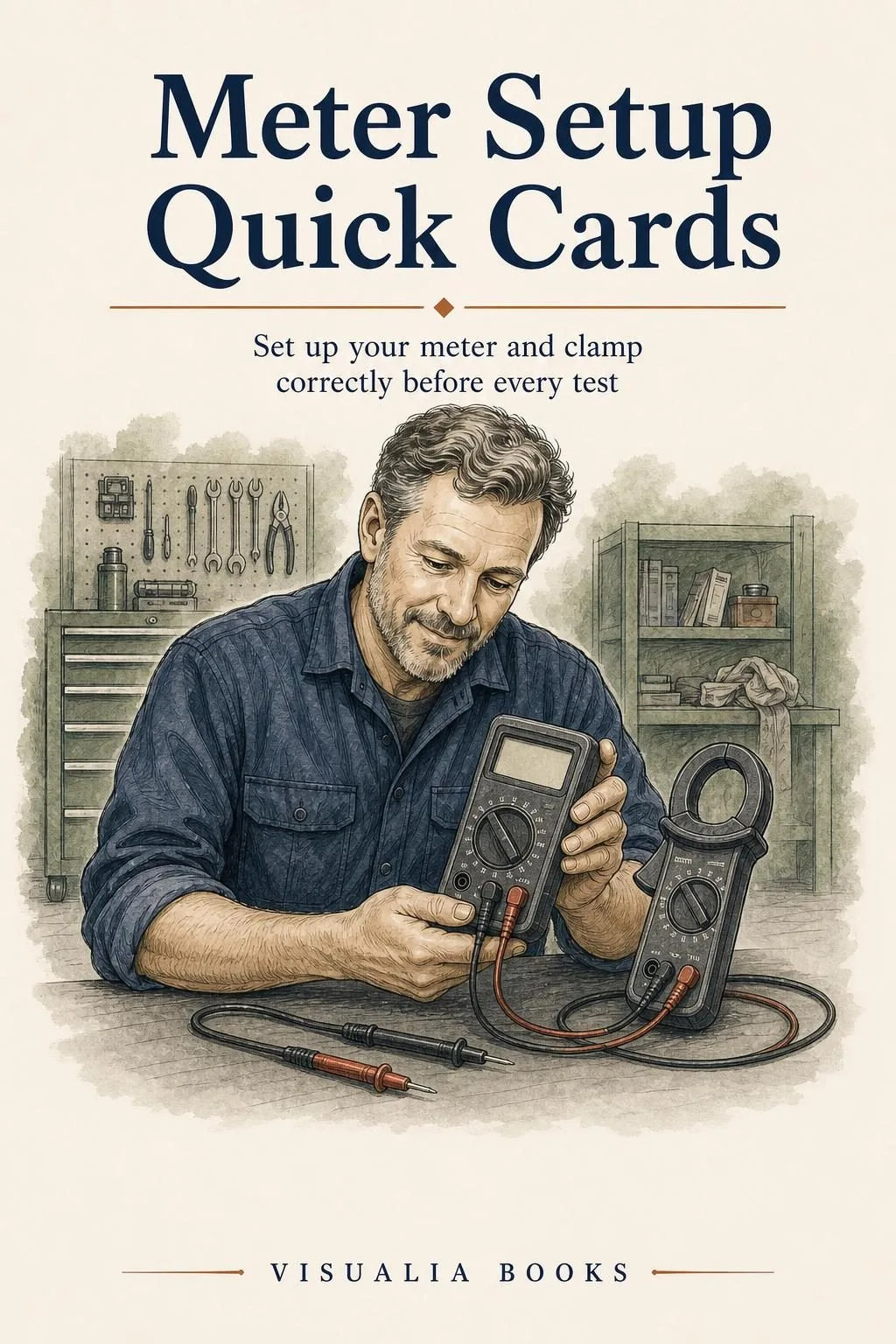
Meter Setup Quick Cards

BONUS 2: «Meter Setup Quick Cards»

Set up your meter and clamp correctly before every test, so a wrong range or a lead in the wrong jack doesn't fool you or damage the meter.

Auto 12V Circuits, Clear Decisions + 2 Free Books

  • Auto 12V Circuits, Clear Decisions: 62 illustrated pages
  • BONUS 1: 12V Diagnostic Log SheetsFREE
  • BONUS 2: Meter Setup Quick CardsFREE
  • High-resolution PDF to printIncluded
YOUR PRICE:
US$ 29.90
BUY NOW

📄 This is a digital PDF book sent to your email: nothing is printed or shipped.

Secure purchaseEncrypted payment30-day guarantee

PDF by email: Auto 12V Circuits, Clear Decisions reaches your inbox as a PDF, and the two free books come by email too. One-time payment, no installments or hidden costs.

Who keeps this page next to the lift

The independent tech who does everything

The independent tech who does everything

You handle varied workshop jobs, have foundational electrical training and use suitable meters and OEM information. You want a visual reminder for the checks covered here.

The fleet or dealer tech who documents every step

The fleet or dealer tech who documents every step

You need to record conditions, test points, units and results. The illustrated reference and included log sheets help keep those details together.

The shop owner who trains newer techs

The shop owner who trains newer techs

You support technicians who already have electrical training. Use the pages to discuss test conditions and evidence while following vehicle-specific procedures.

To Sum Up: Here Is What You Get

US$ 29.90
BUY NOW

📄 This is a digital PDF book sent to your email: nothing is printed or shipped.

30DAYS
GUARANTEE

30-Day Guarantee

30-day guarantee: tell us what didn't work and we'll refund 100%.

30-day money-back guarantee. If the material does not help you organize your checks, contact us within 30 days for a full refund.

Frequently Asked Questions

Is this a printed book or a digital file?

It's a digital PDF. You receive it by email and can read it on any device. You can also print it for your workbench.

Can I read it on my phone?

You can open the PDF on your phone or tablet and zoom into diagrams, or print the pages for your workbench.

I already have OEM service information. What does this add?

It supplies illustrated reminders for the checks covered here. OEM information still supplies the exact circuit, safe access, test conditions and specifications; use the two together.

Is this for beginners?

It is intended for working technicians with foundational electrical training, suitable instruments and access to OEM service information. It does not replace hands-on instruction.

Does it cover my specific make and model?

It illustrates selected conventional 12-volt checks, not every circuit or model. Confirm applicability, access and test conditions in the vehicle-specific service information.

Where does the PDF arrive after checkout?

PDF by email. The book and the two bonus books arrive at the email address you enter at checkout.

Is this a one-time payment?

Yes. You pay once at checkout and that's it — nothing renews and nothing bills again next month.

Does it cover hybrid or electric vehicle high-voltage systems?

No. This book covers conventional 12-volt circuits only. High-voltage EV/hybrid systems, SRS/airbags, and 48-volt architectures are excluded.

Is this an official ASE or manufacturer publication?

No. This is an independent illustrated reference. It is not affiliated with or endorsed by any vehicle manufacturer, tool manufacturer, or certification body.

One Last Thing Before You Decide...

Keep a visual reminder beside your OEM procedure.

Record the reference point, conditions and result.

Choose the next check from the evidence.

Give the checks covered here a place on your bench: 62 illustrated topic pages, plus Diagnostic Log Sheets and Meter Setup Quick Cards.

One-time payment: US$ 29.90 · Guarantee: 30 days · PDF by email

BUY NOW

📄 This is a digital PDF book sent to your email: nothing is printed or shipped.